Learn how to choose the best diesel generator for coastal, offshore, island, and marine environments. Compare 316L stainless steel and galvanized steel enclosures, understand salt spray corrosion, and discover the best anti-corrosion solutions for long-term reliability.
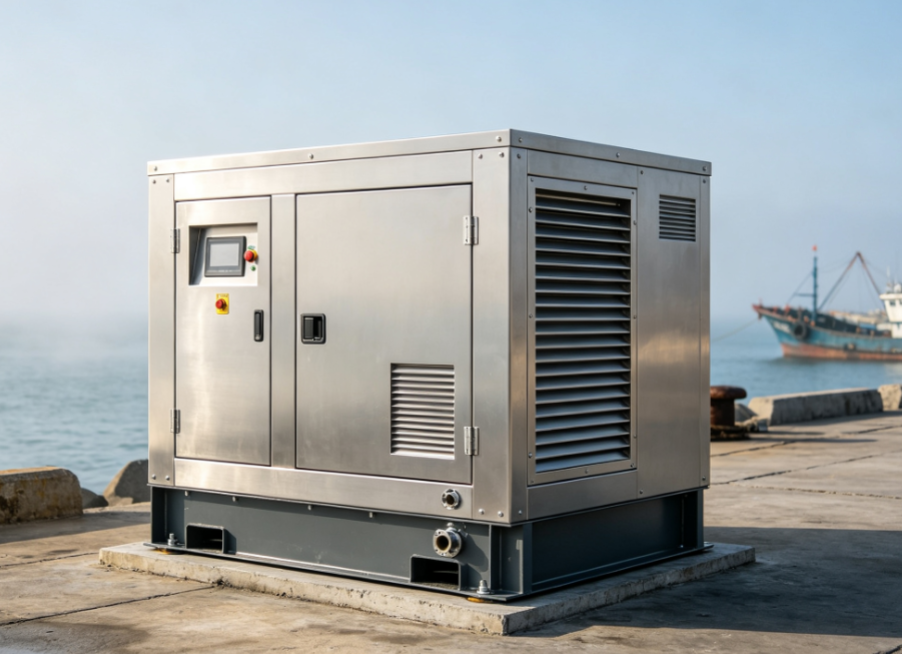
High Salt Spray Diesel Generator: The Ultimate Guide for Coastal and Marine Applications
Why Salt Spray Is the Biggest Threat to Diesel Generators
Diesel generators installed near the ocean face one of the world’s most aggressive operating environments—high salt spray (salt fog) exposure.
Unlike ordinary industrial locations, coastal areas contain airborne chloride particles that continuously attack metal surfaces. Over time, salt deposits accelerate corrosion, reduce insulation performance, and significantly shorten the service life of generator components.
Typical applications include:
- Coastal industrial facilities
- Ports and harbors
- Offshore oil & gas platforms
- Islands
- Shipyards
- Marine terminals
- Desalination plants
- Coastal telecommunications stations
Without proper corrosion protection, even a new generator enclosure can begin to show rust within only a few years.
Therefore, selecting a high salt spray diesel generator specifically designed for marine environments is critical for ensuring long-term reliability and minimizing maintenance costs.
How Salt Spray Damages a Diesel Generator
Salt fog affects much more than the outer enclosure.
It gradually attacks nearly every major component of the generator.
Steel Enclosure
Salt water and humid air continuously corrode exposed steel surfaces.
Once protective coatings are damaged, corrosion spreads rapidly around welded joints, cut edges, hinges, and drainage channels.
Electrical Components
Rust particles and moisture eventually enter the enclosure, affecting:
- Alternator windings
- Generator insulation
- Control panels
- Terminal connections
- Circuit breakers
The result may include insulation failure, electrical leakage, or even short circuits.
Mechanical Components
Corrosion also accelerates wear on:
- Door hinges
- Locks
- Fasteners
- Air louvers
- Cooling fans
These issues increase maintenance frequency and reduce equipment availability.
316L Stainless Steel vs. Galvanized Steel: Which Generator Enclosure Performs Better?
Choosing the right enclosure material is one of the most important decisions for generators operating in coastal environments.
Option 1: Hot-Dip Galvanized Steel
Hot-dip galvanized steel protects the underlying steel by means of a sacrificial zinc coating.
When the zinc layer is damaged by transportation, vibration, welding, or impact, corrosion begins immediately.
Typical Service Life in Coastal Areas (Within 1 km of the Coast)
Standard 80 μm Hot-Dip Galvanized Steel
- White rust after approximately 3–5 years
- Localized red rust develops shortly afterward
- Welded areas and corners become vulnerable to water penetration
Heavy-Duty Galvanized Steel with Multi-Layer Coating
A complete corrosion protection system includes:
- ≥100 μm hot-dip galvanized coating
- Zinc-rich epoxy primer
- Epoxy intermediate coating
- Polyurethane or fluorocarbon topcoat
This system can provide approximately 8–10 years of service life with regular maintenance.
However, repainting is generally required every 2–3 years to maintain corrosion resistance.
Common Weak Points
Galvanized steel enclosures are particularly vulnerable at:
- Weld seams
- Cut edges
- Drainage channels
- Door frames
- Ventilation openings
Once corrosion begins, repairs become increasingly expensive over the equipment’s lifetime.
Option 2: 316L Stainless Steel (Recommended)
316L stainless steel is widely recognized as the preferred material for marine environments.
Unlike galvanized steel, corrosion resistance comes from the alloy itself rather than a surface coating.
The addition of molybdenum (Mo) significantly improves resistance to chloride-induced corrosion and pitting.
Minor scratches generally do not compromise long-term corrosion resistance.
Typical Service Life
304 Stainless Steel
Suitable for light coastal exposure.
Expected service life:
- Approximately 5–8 years in mild marine environments
- Only 3–5 years in severe salt spray conditions
For installations within 1 km of the shoreline, 304 stainless steel is generally not recommended for long-term outdoor service.
316L Stainless Steel
316L provides outstanding resistance to salt spray and chloride corrosion.
Typical service life exceeds 15 years in harsh marine environments with minimal maintenance.
Advantages include:
- Excellent corrosion resistance
- No zinc coating to wear away
- Superior resistance at welds and corners
- Minimal maintenance requirements
- Long-term protection of electrical components
For this reason, 316L stainless steel is commonly used for:
- Offshore platforms
- Marine vessels
- Port facilities
- Coastal substations
- Naval infrastructure
Which Enclosure Should You Choose?
The best solution depends on your operating environment and expected service life.
Scenario 1: Coastal Outdoor Installation (Within 1 km of the Shoreline)
Typical applications:
- Ports
- Islands
- Offshore platforms
- Marine terminals
Recommended Solution
A 316L stainless steel enclosure is strongly recommended.
Suggested specifications include:
- Minimum 2.0 mm thick 316L stainless steel
- 316L stainless steel hinges, locks, and fasteners
- Pickled and passivated weld seams
- Internal reinforcement fabricated from 316L stainless steel to prevent galvanic corrosion
Although the initial investment is higher, lifecycle costs are significantly lower due to reduced maintenance and longer service life.
Scenario 2: Medium-Term Projects with Budget Constraints
Typical applications:
- Temporary projects
- Coastal facilities with protective buildings
- Equipment expected to operate for 5–8 years
A heavy-duty galvanized enclosure may be acceptable if the following requirements are fully implemented:
- ≥100 μm hot-dip galvanized steel
- Zinc-rich epoxy primer
- Epoxy intermediate coating
- Polyurethane or fluorocarbon finish coat
- Repair of all welded and cut surfaces
- Annual inspections
- Repainting every 2–3 years
Bare galvanized steel without additional protective coatings is not recommended for high salt spray environments.
Scenario 3: Inland Installations (More Than 3 km from the Coast)
For indoor installations or locations with relatively low salt exposure:
- 304 stainless steel
- Standard hot-dip galvanized steel with powder coating
These materials generally provide satisfactory performance.
Additional Anti-Corrosion Measures
Even the best enclosure material should be combined with comprehensive corrosion protection.
Recommended options include:
- Marine-grade salt spray air intake louvers
- Improved drainage design to prevent standing salt water
- Anti-condensation space heaters
- Protective coating on alternator windings
- Conformal coating on electronic control boards
- 316 stainless steel bolts, hinges, and fasteners
- IP55 or higher alternator protection
- C5-M marine anti-corrosion coating system in accordance with ISO 12944
These measures help maximize service life and improve operational reliability in marine environments.
Why Choose a Marine-Grade Diesel Generator?
A generator designed specifically for high salt spray environments offers several long-term advantages:
- Longer equipment lifespan
- Reduced maintenance costs
- Improved electrical reliability
- Lower risk of corrosion-related failures
- Better protection of alternators and control systems
- Higher availability for mission-critical operations
For remote islands, offshore facilities, ports, and coastal industrial plants, investing in a marine-grade generator significantly lowers the total cost of ownership.
Conclusion
Choosing the right enclosure material is one of the most important decisions when purchasing a diesel generator for coastal or offshore applications.
For long-term outdoor operation in severe salt spray environments—especially within 1 km of the coastline—a 316L stainless steel enclosure offers the best combination of corrosion resistance, durability, and low maintenance.
For projects with limited budgets or shorter service life requirements, a heavy-duty hot-dip galvanized steel enclosure with a complete multi-layer anti-corrosion coating system can provide acceptable performance when properly maintained.
At ECOVOLTS, we design and manufacture customized diesel generator solutions for some of the world’s most demanding environments, including coastal infrastructure, ports, islands, offshore platforms, mining operations, and marine applications. Our engineering team can tailor enclosure materials, coating systems, IP protection ratings, and corrosion-resistant components to meet your specific project requirements and ensure reliable performance throughout the generator’s service life.
Post time: Jul-08-2026